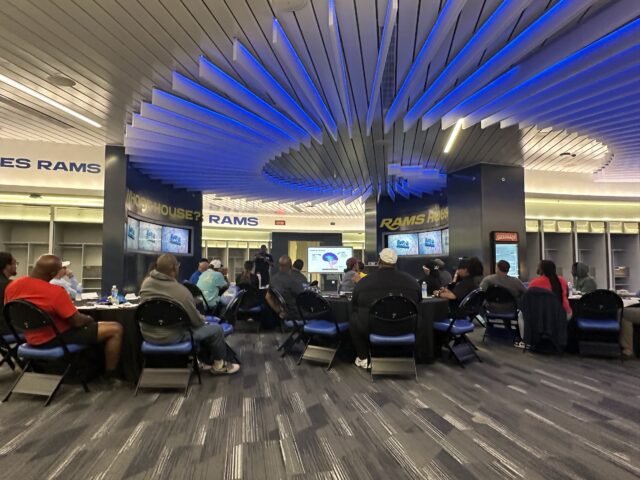
 Los Angeles Rams and Center for Healing and Justice through Sport healing-centered Coach Learning Cohort
Los Angeles, CA. Summer 2026. With support and investment from the Los Angeles Rams, the Center for Healing and Justice through Sport (CHJS) trained a cohort of 30 local youth coaches working in boys’ and girls’ flag and tackle football. The program gave coaches tools to support their athletes’ mental health on and off the field through healing-centered sport and brain-based coaching. It focused on the brain science behind stress, connection, and self-regulation to help coaches build safety and trust with their athletes.
The training kicked off in the Rams’ Locker Room at SoFi Stadium, where coaches dug into the material and started building community. It paid off from session one. Chad Hogancamp, CEO of OC Waves, an Orange County youth sports organization, went home after the first session and started talking with his own coaches and parents about how to combine the fun of sport with skill development.
For the fourth session, coaches gathered at YouTube Theater for a discussion on implicit bias before the Rams’ preseason game against the New Orleans Saints. They then stayed for the game. One coach got to test his brain-based coaching on a very big stage: at halftime, his flag football team took the field at SoFi Stadium in front of tens of thousands of fans.
He later told Chris Reed, CHJS Director of Partnerships and lead facilitator of the project, that a few months earlier he wouldn’t have known what to do with that moment. The kids were excited, overwhelmed, and taking in the size of the crowd. Using what he had learned through the cohort, he led them through regulation activities, stayed close, and watched to see if they felt safe. By the second play, the kids were calm, running their routes, and high fiving with abandon.
That shift in confidence showed up across the cohort. Among coaches who completed the post-training survey, 100% said they felt more confident in their ability to be a healing-centered coach. The share reporting high or very high knowledge of youth development, adversity, and the brain jumped from 27% before the training to 100% after. Confidence in creating a sport environment that maximizes the benefits for young people also grew, from 45% to 100%.
Coaches also left with practical strategies to take back to their teams. Every survey respondent said they gained new tools to support youth mental health and strengthen connections within their programs.
The Rams have consistently backed coaches as crucial figures in supporting young people’s wellbeing. “Athlete mental health and well-being is a top priority,” said Ellie Greenberg, Coordinator of Community Impact and Engagement for the Rams. “Coaches play a pivotal role in bringing these important conversations to their teams and in establishing the culture. When designing this cohort, we strived to equip youth coaches with practical tools and resources that would not only support their athletes’ wellbeing today but also help create lasting practices within their programs.”
Greenberg’s interest in this work is rooted in her own experience as an athlete. “As a former athlete with a background in mental health education, this work is especially meaningful to me. I love using the power of sports to create space for conversations that I wish more athletes had growing up, and it’s exciting to help coaches feel more prepared to support them both on and off the field.”
Reed saw that commitment play out across each session. He spent the summer with a group of coaches who came in carrying many of the traditional “play through it” instincts often associated with football. Over time, he watched them build trust with one another, engage with the material, and think differently about how they support young athletes.
“Any time you get coaches together in a cohort, watching them connect and grow is incredibly rewarding, especially with football coaches,” said Reed. “There’s a coaching culture built around toughness, and getting through to them what healing-centered sport actually looks like, and how to still be a supportive coach who makes room for a kid to show up as their full self, is real work. But we saw it happen. By the final week, even over Zoom, there were real friendships, respect, and camaraderie that came out of these short, focused sessions.”
LOOKING AHEAD
The second CHJS Coach Learning Cohort launches in spring 2027 for high school girls’ flag and boys’ tackle coaches. CHJS and the Rams look forward to continuing this work together.
Apply to join the next cohort [here].